-
 Galerie Klatovy / Klenová
- Před 2 roky
- Blog
We Didn’t Do It! Crew / Mud
Klenová Grannary 2. 6. - 8. 9. 2024 openning reception 1. 6., 15:00
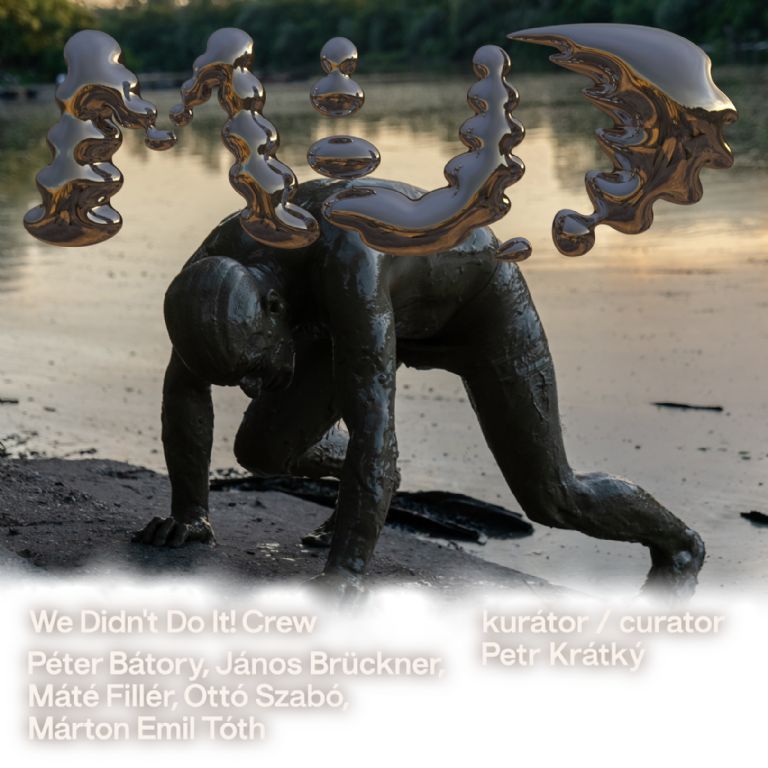
Péter Bátory, János Brückner, Máté Fillér, Ottó Szabó, Márton Emil Tóth
(Mudboys: János Brückner, Márton Emil Tóth)
Curator: Petr Krátký
Exhibition graphic design: Šimon Vlasák a Markéta Mášová
“We wanted to escape the routine of our lives, if only for a while. We didn't know exactly why, nor what to expect. We were interested in transforming into a new existence. In changing our being. Nature itself made this metamorphosis possible. The human body completely covered in mud loses the characteristics of a civilized human being and becomes only half human and half something else – nature, matter, instinct – neither good nor bad.”
Mudboy is the current alter ego of a group of five Hungarian artists who have spent the past fifteen years working together as the Nem mi voltunk! Crew (We Didn't Do It! Crew). Each member of this loose grouping – Péter Bátory, János Brückner, Máté Fillér, Ottó Szabó, and Márton Emil Tóth – forms a unique and inimitable part of the whole, which is characterized by a broad spectrum of artistic approaches ranging from traditional disciplines such as painting, sculpture or printmaking all the way to new media or drama.
The exhibition possesses a clearly articulated message and uses various media to outline the complicated nature of the world today. It offers a potential guide for a deeper understanding of this world in the form of Mudboy, a figure situated somewhere between the world of man and the natural world. A creative existence, he questions conventional notions of the conditions underlying our actions and the consequences and implications of being in the world, while also offering a potential alternative. Depending on the particular conditions or situation, this invented figure is just another version of itself, a guide through changing images, events, and stories.
The natural elements – earth, water, fire and air – have formed our landscape and even us since time immemorial. They exist in relation to one another. Mud is the combination of water and earth. It represents something ugly or dirty, but also useful and life-giving. Not by coincidence, the artists use it in a manner recalling ancient rituals. Mud is thus a reference that guides us through the history of human civilizations: starting with fields where regular floods bring mud to fertilize the soil, continuing to cities where water and clay are mixed and dried in the sun to build solid homes, and on to the firing of mud in kilns to produce solid, yet fragile stoneware. The earliest writing has been preserved on clay tablets. Mud is a natural mixture that, as history tells us, offers an almost endless range of uses. Nor can we deny its almost miraculous healing effects…
Thanks to its reversibility, we can let water evaporate from mud to separate the various elements and start the cycle over from the beginning.
Artificially created boundaries can be transcended.
A recognition of the unquestionable importance of nature is essential for the further healthy development of society, which is constantly changing and can thus be as unpredictable as, for instance, destructive landslides.
The exhibition touches on questions currently resonating in society, such as the environmental crisis, the search for sustainable renewable resources, or attempts at minimizing our environmental footprint. It possesses a real potential to speak to all who choose to be open to the solutions it presents.
Working with the inherent potential of natural forces, the exhibition explores the transformation of the human body as a tool by which we understand the world around us and which, for various reasons, not only civilizational, we may cease to understand.
The original selection of objects, photographs, videos, and performances represents a coherent body of work from the past four years, with a focus on the works' sensory aspects and the possibility of experiencing them physically.





Galerie Klatovy / Klenová
Klenová - hrad, zámek, galerie. Galerie U Bílého jednorožce v Klatovech. Kostel sv. Vavřince v Klatovech.